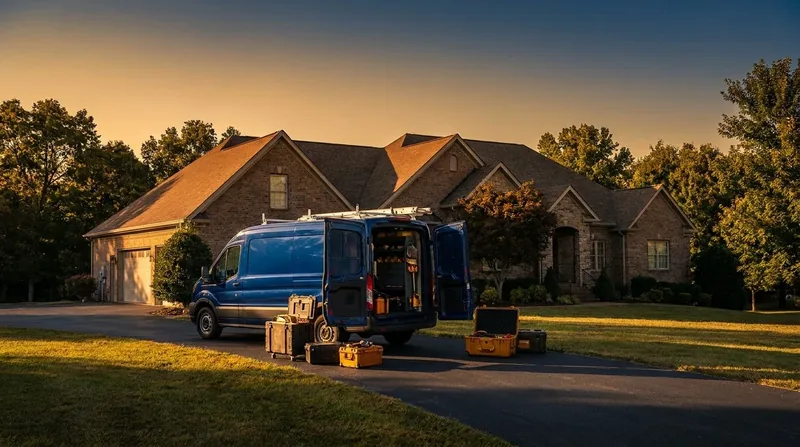
How to Start a Pressure Washing Business in Ohio
How to Start a Pressure Washing Business in Ohio
This article is informational, not legal or tax advice. Rules and fees change, so confirm each figure on the agency page linked below before you file or pay.
Ohio does not issue a pressure washing license, so if you searched for one, you can stop looking. There is no state trade license, no statewide contractor license, and no county business license for this work. That is good news for a new operator, but it can be misleading. Washing the outside of a building is a taxable service in Ohio, so you will likely need a sales tax vendor’s license. Your wash water is also an environmental issue, and cities and villages can add their own rules. This guide walks through the steps in the order most new operators handle them.
What You Need Before You Start
Pull these together before you file anything. Equipment costs vary widely, so treat this list as a planning checklist, not a budget.
- Two wash systems: a high-pressure machine for concrete and hard surfaces, and a low-pressure soft wash setup for siding, roofs and windows
- Surface cleaners, extension wands, hoses and a set of nozzle tips
- Cleaning chemicals selected for each surface type, plus the safety data sheet (SDS) for every product
- A truck or trailer with a secure chemical tank and a locked storage area
- Wash water containment gear for jobs near storm drains, such as mats, berms or a recovery vacuum
- A business bank account and bookkeeping software that separates taxable and nontaxable work
- Commercial general liability insurance and commercial auto coverage, arranged through an insurance agent
- A legal business name, an Ohio business address and a statutory agent in Ohio (required if you form an LLC)
Step 1: Confirm What Ohio Requires for Your Work
Ohio has no state pressure washing license. Ohio also issues no single general state business license. The Ohio Department of Taxation says the licenses and permits a business needs depend on the type of work and come from state agencies, counties or cities. For a pressure washer, the registration that matters most is the sales tax vendor’s license, covered in Step 5.
Next, check the city or village where you will work. Some municipalities set their own business or contractor registration rules, and they handle those locally. Contact the city or village clerk or building department before your first job, and ask about each city you plan to serve. Counties issue no business license, but the county auditor does issue the sales tax vendor’s license under state law.
Step 2: Choose a Legal Structure
You have two common options. Structure affects your liability, your taxes and your paperwork, so talk to an Ohio attorney and a CPA before you decide if your situation is complicated.
- Sole proprietorship. You and the business are the same legal person, and there is no formation filing. If you operate under any name other than your own, such as a company name on your truck, you must register a trade name (Step 3).
- Limited liability company (LLC). An LLC separates your personal assets from most business debts and claims. Formation requires Articles of Organization, covered in Step 4.
Both structures face Ohio’s business taxes. The Commercial Activity Tax (CAT) is a gross receipts tax of 0.26% on Ohio taxable gross receipts, but only above a $6 million exclusion for 2025 and later. Most small pressure washing operations will fall below that level, but confirm your own numbers with the Department of Taxation. Taxable business income is taxed at a flat 3%, and cities and villages also tax business net profit under their own rates.
Step 3: Pick and Protect Your Business Name
- Search the name. Use the Ohio Secretary of State business search at https://businesssearch.ohiosos.gov/. An LLC name must be distinguishable from the name of any other domestic or foreign LLC, corporation, limited partnership, limited liability partnership or registered trade name, unless the prior holder consents in writing.
- Use an accepted LLC ending. An Ohio LLC name must include “limited liability company” or one of these: “L.L.C.,” “LLC,” “limited,” “ltd.” or “ltd.”
- Reserve it if you need time. A name reservation holds the name for 180 days and costs $39.
- Register a trade name if you need one. Trade names, also called fictitious names, are registered with the Ohio Secretary of State, not the county. Registration uses Form 534A and costs $39. Renewal is $25 every five years, and an update or change of registrant name is $25.
Step 4: Appoint a Statutory Agent and File Articles of Organization
Ohio calls the registered agent a statutory agent. Every LLC must appoint one and maintain one continuously. The agent must be either an Ohio resident who is a natural person, or an entity with a business address in Ohio. The listed address must be a street address. A post office box does not qualify, even one with a street address attached. The Secretary of State will not accept Articles of Organization unless they come with a written appointment signed for the company and a written acceptance signed by the agent on the prescribed form.
File Articles of Organization for a Domestic Limited Liability Company (Form 610) for a $99 filing fee through Ohio Business Central at https://www.ohiobusinesscentral.gov/. Regular service takes 3 to 7 business days from receipt, and filing online is the fastest standard route. Expedited options cost more. Expedite Service 1 is $100 above the filing fee and is processed within 2 business days. Expedite Service 2 is $200 and is processed within 1 business day. Expedite Service 3 is $300, requires in-person delivery, and is processed within 4 hours if received by 1:00 p.m., otherwise by noon the following business day.
Two ongoing points matter after filing. Ohio LLCs file no annual or biennial report. Changing your statutory agent or its address, or filing a resignation, costs $25. A resignation takes effect 30 days after it is filed.
Step 5: Register for Sales Tax and Know When Ohio Taxes Your Service
This is the step that trips up most pressure washers. Ohio’s sales tax definition includes “building maintenance and janitorial service,” which covers cleaning the interior or exterior of a building and the property on it (ORC 5739.01(B)(3)(j) and (II)). Exterior building washing is therefore a taxable service unless you fall under the threshold below.
The rule has a threshold. A provider whose sales of this service stay under $5,000 in a calendar year is outside the definition. Once you pass that amount, you need a vendor’s license and must collect sales tax. The vendor’s license costs $50 per fixed place of business under ORC 5739.17. Apply through the Ohio Business Gateway or your county auditor. Confirm with the Department of Taxation how the $5,000 is counted when a year mixes taxable and nontaxable work.
The building definition does not settle every job. For driveways, decks, fences and other real property, ask the Department of Taxation how the service is classified before you quote it. Ask about residential jobs as well, because a homeowner is a different customer than a property manager.
Once registered, you charge the 5.75% state sales tax rate plus the county and transit authority rates that apply, and you remit what you collect. Those local rates vary, so confirm the rate for each county where you work. Keep separate records for taxable and nontaxable work from the first invoice.
Step 6: Handle Wash Water Before You Wash Anything
Wash water that carries detergents, oil or paint chips must not reach storm drains. Storm drains typically empty into local streams and rivers without treatment, so this is the rule most likely to draw a complaint from a neighbor or an inquiry from a regulator. Ask Ohio EPA and your local stormwater office what they require for reclaiming or containing wash water on your type of job. Get those answers in writing if you can.
Practical ways to stay compliant include:
- Use containment mats or berms on driveways and parking areas that slope toward a drain
- Use a vacuum recovery system on sites with heavy staining or paint removal
- Sweep debris and paint chips before washing, and keep them out of gutters
- Read each product’s SDS for disposal and runoff notes before you mix
Labels such as “biodegradable” do not by themselves make a discharge acceptable. Check the rules for your location and the SDS before you assume a product is safe to release.
Step 7: Set Up Workers’ Compensation Before Your First Hire
Ohio workers’ compensation comes from the state fund administered by the Ohio Bureau of Workers’ Compensation (BWC). It is a monopolistic state fund, so private carriers do not write this coverage for Ohio employers. BWC coverage is required once you have employees. Get a federal employer identification number (EIN) from the IRS before you run payroll, and set up BWC coverage before any employee starts work. Confirm the enrollment steps and premium with BWC directly, because the agency sets them.
Step 8: Price Your Work and Set Expectations
Price by surface type, square footage or a flat fee per job, and put the scope in writing. Spell out what is included, what is excluded, how you protect landscaping and what happens if a stain does not come out. Many contractors ask for a deposit on new commercial accounts.
Set expectations in specific, hedged terms. Pressure washing and soft washing can often remove surface dirt, mildew, algae and light grime from many exterior surfaces. Results depend on the age and condition of the surface, how long the staining has been there and the cleaning product used. Rust, oil and deep paint stains may only partly lift, and some older siding or mortar can be damaged by high pressure. Tell customers those limits before the job, not after.
Common Mistakes to Avoid
- Assuming there is a state pressure washing license. There is none, but city or village rules may still apply to your work.
- Ignoring the sales tax threshold. Once you pass $5,000 in a calendar year, collecting tax without a vendor’s license creates a problem you will have to fix.
- Using a post office box for your statutory agent. Ohio will not accept it, and your filing will stall.
- Letting wash water reach storm drains. Containment is far easier to set up before the first job than to explain afterward.
- Using the same pressure on every surface. Vinyl siding, wood and old mortar need lower pressure and different chemistry than concrete.
- Hiring before workers’ compensation is in place. Start the BWC setup before the first paycheck.
- Quoting without a written scope. Verbal quotes lead to disputes over surface area and stain removal.
- Running without liability insurance. One damaged window or flooded basement can cost more than many jobs earn.
Costs at a Glance
The table lists only the state figures covered in this guide. Equipment, insurance and any city fees are not listed because they vary, so confirm them with each provider or city.
| Item | Cost | Where to file or pay |
|---|---|---|
| Articles of Organization (Form 610) | $99 filing fee | Ohio Business Central |
| Expedited LLC filing | $100, $200 or $300 above the filing fee, depending on speed | Ohio Business Central |
| Name reservation (180 days) | $39 | Ohio Secretary of State |
| Trade name registration (Form 534A) | $39; renewal $25 every five years | Ohio Secretary of State |
| Change of statutory agent, address or resignation | $25 | Ohio Secretary of State |
| Sales tax vendor’s license | $50 per fixed place of business | Ohio Business Gateway or county auditor |
| LLC annual or biennial report | Not required | Not applicable |
| Commercial Activity Tax | 0.26% above the $6 million exclusion (2025 and later) | Ohio Department of Taxation |
| State sales tax rate | 5.75% plus county and transit authority rates | Ohio Department of Taxation |
| Workers’ compensation | Set by BWC; required once you have employees | Ohio Bureau of Workers’ Compensation |
Official Resources
- Ohio Secretary of State: https://www.ohiosos.gov/
- Ohio Business Central (online filing): https://www.ohiobusinesscentral.gov/
- Ohio business name search: https://businesssearch.ohiosos.gov/
- Trade name and business forms: https://www.ohiosos.gov/business/business-filing-forms/
- Ohio Department of Taxation: https://tax.ohio.gov/
- Vendor’s license information: https://tax.ohio.gov/business/ohio-business-taxes/sales-and-use/vendor-licensing
- Ohio Small Business Development Centers: https://clients.ohiosbdc.ohio.gov/
- SBA resources for Ohio: https://www.sba.gov/district/ohio
Ohio EPA and the Ohio Bureau of Workers’ Compensation publish their own guidance on their websites, and your city or village will have a contact page for local registration questions.
Important Disclaimer
This article is informational only. It is not legal, tax or insurance advice, and reading it does not create an attorney-client or CPA-client relationship. Ohio rules, fees and thresholds change, so check the agency page for current figures. Before you form an entity, register for taxes or sign contracts, confirm each item with the named agency. Talk to a qualified Ohio attorney and a CPA, especially if you plan to hire, work on commercial sites or operate in more than one city.
Keep exploring: related Ohio guides
- How to Start a Pest Control Business in Ohio
- How to Start a Snow Removal Business in Ohio
- How to Start a Lawn Care Business in Ohio
- How to Start a Cleaning Business in Ohio
- Ohio Contractor License
- How to Start an LLC in Ohio
- Ohio Business License
- How Much Does It Cost to Start a Business in Ohio
- All Ohio business types
- Every Ohio guide in one place