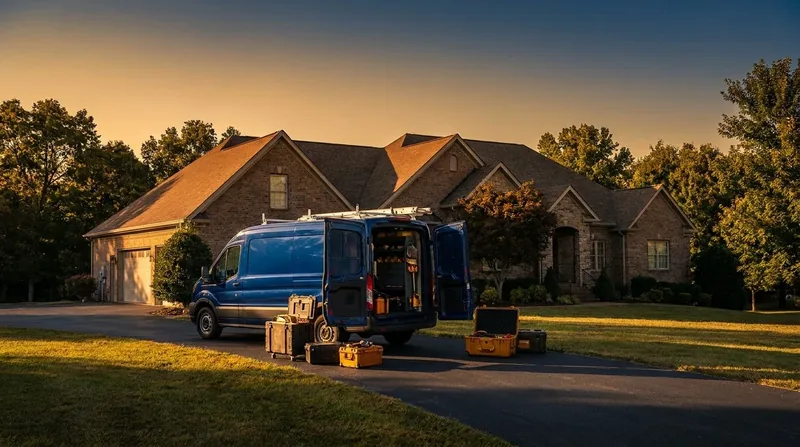
How to Start a Tree Service Business in Ohio
How to Start a Tree Service Business in Ohio
Starting an Ohio tree service is mostly about putting ordinary registrations, insurance and local permits in the right order. Ohio has no state tree service license. It also has no state general business license, no statewide general contractor license, and counties do not issue a business license. What you need depends on the work you sell. Removals, trimming, stump grinding, storm cleanup and pesticide applications each bring different paperwork. This guide walks through the sequence we would follow if we were filing for the first time.
Disclaimer: This article is informational content, not legal or tax advice. Fees, thresholds and agency rules change, so confirm every figure with the agency named before you spend money. For questions about your entity choice, contracts, taxes or liability, talk to a qualified attorney or CPA.
What You Will Need Before You File
Gather these items before you start the formal steps. Most of them you will use again in your first year.
- A business name checked on the Ohio Secretary of State's search tool at businesssearch.ohiosos.gov
- A street address in Ohio for your statutory agent (a post office box will not work)
- A federal Employer Identification Number (EIN) from the IRS, which is free at irs.gov
- An account on Ohio Business Central at ohiobusinesscentral.gov for filing
- A written operating agreement, if you form an LLC with more than one owner
- Quotes for general liability and commercial auto insurance
- A workers' compensation quote from the Ohio Bureau of Workers' Compensation (BWC), once you know you will have employees
- A list of your planned services and equipment, plus any pesticide products you expect to apply
Step 1: Choose Your Business Structure
Your first decision is whether to operate as a sole proprietor, an LLC or a corporation. Each has different filing costs and different exposure. Most owner-operators choose an LLC because it can separate business debts and contract claims from your personal assets. It does not protect you from your own negligence on a job site, so insurance remains essential for tree work.
| Structure | Formation filing fee | Annual or biennial report |
|---|---|---|
| Sole proprietorship | None to form, but a trade name registration is $39 if you use a name other than your own | None |
| LLC (Articles of Organization, Form 610) | $99 | None required |
| Corporation (Articles of Incorporation, Form 532A) | $99 | None required for for-profit corporations |
Ohio has no franchise tax and no LLC annual tax. Ohio also has no corporate income tax. Ohio taxable business income is taxed at a flat 3% at the state level, and many cities and villages tax business net profit under their own rates. Confirm how your entity is treated for state and local income tax with a CPA before you choose.
Step 2: Choose and Protect Your Name
An Ohio LLC name must contain the words “limited liability company” or one of these abbreviations: “L.L.C.”, “LLC”, “limited”, “ltd.” or “ltd”. A name like Buckeye Tree Experts LLC meets the rule. The name must also be distinguishable on the Secretary of State's records from other LLCs, corporations, limited liability partnerships, limited partnerships and registered trade names, unless the prior holder gives written consent.
You can reserve a name for 180 days for $39. Reserving the name helps if you are still choosing a company name, lining up insurance or waiting on a logo. If you plan to operate under a name different from your legal name, register it as a trade name with the Ohio Secretary of State for $39.00. Trade names are not registered with the county. The renewal is $25.00 every five years, and an update or change of registrant name is $25.00.
Step 3: Appoint a Statutory Agent
Ohio calls the registered agent a statutory agent, and every LLC must appoint one and keep one in place. The agent must be an Ohio resident or an entity with a business address in Ohio. The address must be a street address, not a post office box, even one with a street address attached. The Secretary of State will not accept your articles without a written appointment signed for the company and a written acceptance signed by the agent on the prescribed form.
Many owners use the company's own shop or a commercial agent service. Using a commercial agent is a real cost, so get the current price from the provider before you assume it is cheap. Changing an agent, an agent's address or filing a resignation costs $25. A resignation takes effect 30 days after it is filed, so plan for that gap if you ever move.
Step 4: File Your Articles of Organization
File Form 610, Articles of Organization for a Domestic Limited Liability Company, through Ohio Business Central at ohiobusinesscentral.gov. The filing fee is $99. Regular processing takes 3 to 7 business days from receipt, and online filing is the fastest standard route. If you need the company formed sooner, these expedite options apply:
| Option | Added cost | Processing |
|---|---|---|
| Regular service | None beyond the $99 filing fee | 3 to 7 business days |
| Preclearance review | $50 | 1 to 2 business days |
| Expedite Service 1 | $100 above the filing fee | Within 2 business days of receipt |
| Expedite Service 2 | $200 | Within 1 business day |
| Expedite Service 3 | $300, in-person delivery required | Within 4 hours if received by 1:00 p.m., otherwise by noon the next business day |
Expedited filings go to P.O. Box 1390, Columbus, OH 43216. Ohio LLCs file no annual report, so your next state filing obligation is tax related, not a yearly corporate report. Your operating agreement is an internal document you keep with your records. It is not part of Form 610.
Step 5: Register for Sales Tax and Understand Your Taxes
Ohio issues no single general state business license, but the vendor's license is the near universal registration. If your business sells taxable goods or services, you must obtain one before making taxable sales. The application fee for a county vendor's license is $50 as of April 9, 2025. You can apply through the Ohio Business Gateway or the county auditor. Learn more at tax.ohio.gov.
The sales tax question is the one most tree owners get wrong. Under Ohio law, tree removal, cutting, trimming and pruning of ornamental trees fall within the taxable “landscaping and lawn care service” definition (ORC 5739.01(B)(3)(g) and (DD)). The exception is for businesses with less than $5,000 in such sales in the calendar year. Track these sales from your first job, because the exception depends on your actual totals. A vendor's license costs $50 per fixed place of business under ORC 5739.17, and the state rate is 5.75% plus county and transit rates that vary by county.
Hazard removals, stump grinding and storm work are not settled in this guide. Ask the Ohio Department of Taxation how each charge is classified before you quote those jobs. Ask in writing if you can, and keep the answer in your file.
The Commercial Activity Tax (CAT) is a gross receipts tax at 0.26% (.0026) on Ohio taxable gross receipts. For tax year 2025 and later, only businesses with more than $6 million of Ohio taxable gross receipts owe the CAT or must register. Most new tree services will fall below that line, but confirm your position with the Department of Taxation as your revenue grows. CAT returns are filed quarterly for those who must file.
Step 6: Get Pesticide Licenses If You Spray
Removals and pruning do not require a pesticide license. Insect treatments, disease treatments and other pesticide applications do. Under ORC chapter 921, you need an Ohio Department of Agriculture (ODA) commercial applicator license and a pesticide business license. Each costs $35 under OAC 901:5-11-03 and 901:5-11-04. Check with ODA at agri.ohio.gov about exam requirements and whether your specific service triggers both licenses before you advertise spraying.
Step 7: Set Up Workers' Compensation Before You Hire
Workers' compensation in Ohio is bought from the state BWC fund, not from a private carrier. You must have coverage once you have employees. Tree work sits in a high-hazard rate class, so get a BWC rate quote before you price jobs. A rate you discover after you sign a contract cannot be fixed on the spot. Ask BWC at bwc.ohio.gov how owner coverage works for your entity, because an owner who works on the crew may need a different answer than an employee.
Step 8: Check Local Permits and City Taxes
Many cities and villages require a permit to remove street trees or protected trees. Rules vary by municipality, and as of 2026, check your municipality before you bid on removals in town. Ask about tree protection ordinances, right-of-way work and any required contractor registration. Cities and villages also tax business net profit under their own rates, so ask the local income tax office where your business is located and where you will perform work.
Step 9: Buy Insurance and Equipment
Your core insurance is general liability, commercial auto and workers' compensation. Many commercial and municipal clients will ask for a certificate of insurance before you start, and some will name themselves as additional insured. Ask an independent agent to quote the limits your clients expect, and do not rely on a limit you have only seen on a competitor's website.
Your equipment list depends on your services, but most crews need chainsaws, climbing or rigging gear, a chipper, a truck or trailer that can haul debris, and personal protective equipment. Stump grinding adds a grinder. Buy used or rent until you have steady work, and log every purchase, because equipment records support your tax and insurance files.
Ohio has no state tree service license, but the ISA Certified Arborist credential from the International Society of Arboriculture is optional and often expected by customers. Certification is not a legal requirement. Many commercial clients and municipal bid documents still ask for it, so plan for the exam fee and study time if your target customers include them.
Step 10: Price, Contract and Market Your Work
Build every quote from the full cost of the job: crew labor, equipment wear, fuel, insurance, debris disposal, permits and sales tax where it applies. Put every job in a written contract that names the scope, the price, the cleanup standard and what happens if the tree has hidden damage. Keep copies of signed proposals, photos before and after each job, and your certificate of insurance on file.
For local visibility, claim your Google Business Profile, list your services accurately, and ask satisfied customers for reviews. Keep your business name, address and phone number consistent across every listing.
Common Mistakes to Avoid
- Naming the LLC without the required words or abbreviation, which delays acceptance.
- Using a post office box as the statutory agent address.
- Assuming a county issues a business license. Ohio counties do not, and trade names go to the Secretary of State.
- Treating ornamental tree trimming as non-taxable and skipping the vendor's license when your sales pass $5,000.
- Guessing the tax treatment of stump grinding, storm work or hazard removals instead of asking the Department of Taxation.
- Applying pesticides before the ODA commercial applicator and business licenses are in place.
- Pricing a job before you have a BWC rate quote for your crew.
- Removing a street or protected tree without checking the city or village permit rules first.
- Running without a written contract or certificate of insurance.
What Results to Expect
Owners who file cleanly, track taxable sales and carry the right insurance often find the early months less stressful, because fewer problems surface at tax time or during a bid. Results vary widely by market, season, local competition and how much work you can take on. This article does not promise revenue, profit or a particular number of jobs. Treat the steps above as the paperwork you may need, and confirm each requirement with the agency that administers it.
Your Startup Checklist
- Check and reserve your name, and register any trade name at the Secretary of State.
- Appoint an Ohio statutory agent with a street address.
- File Form 610 for $99 through Ohio Business Central, choosing an expedite option if needed.
- Obtain your EIN from the IRS.
- Apply for your vendor's license for $50 per fixed place of business, and ask the Department of Taxation about any unclear services.
- Apply for ODA licenses before any pesticide work.
- Get insurance quotes and a BWC rate quote before your first hire.
- Confirm local permit rules and city or village tax obligations.
This content is informational and is not legal or tax advice. Before you commit to an entity, a contract structure or a tax position, consult a qualified Ohio attorney and a CPA who works with contractors.
Keep exploring: related Ohio guides
- How to Start a Maple Syrup Business in Ohio
- How to Start a Christmas Tree Farm in Ohio
- How to Start a Farm Market or CSA in Ohio
- How to Start a Dog Breeding or Kennel Business in Ohio
- How to Start an LLC in Ohio
- Ohio Business License
- How Much Does It Cost to Start a Business in Ohio
- All Ohio business types
- Every Ohio guide in one place